
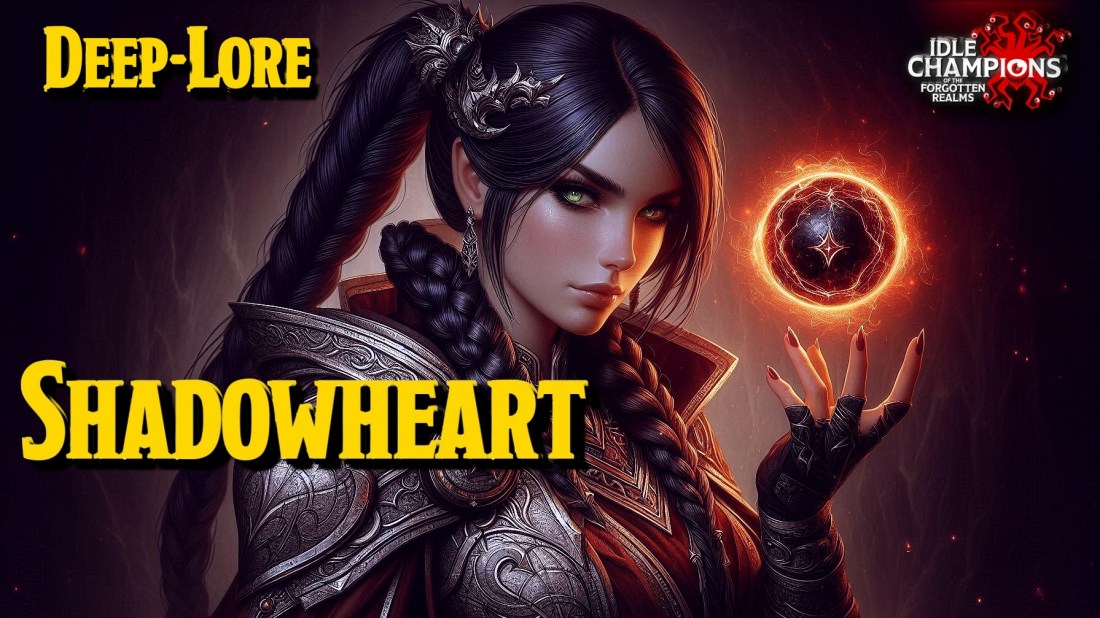
Shadowheart is a character built on contradictions. She moves through the world as if she’s always halfway in shadow, halfway out of reach, and that is very much by design. Her past is hidden, her loyalties are layered, and even when she speaks plainly, there’s always the sense that something remains behind a locked door. To understand her, you have to accept that she is a puzzle that doesn’t want to be solved too quickly. And that is the charm. Not perfection, not heroism, but a person trying to reconcile the fragments of a life she didn’t choose.
She begins as a cleric of Shar, the Mistress of the Night, a goddess who thrives on secrecy, loss, and the erasure of emotion. Shar doesn’t ask for devotion; she demands it. In her service, memories are tools, pain is discipline, and the self is something to be shaped rather than discovered. Shadowheart was molded through that philosophy. She didn’t grow into her beliefs. She was sculpted into them.
Her earliest history is hidden even from herself. Not metaphorically, but literally. Her memories were sealed away by her own order, her identity carefully rewritten to protect a mission she was trained to carry out without hesitation. She was not meant to question her past. She was meant to obey, to serve Shar’s will without pause, and to keep her secrets even from herself. And that is important, because it means she begins her journey with an artificial certainty. A certainty built on missing pieces.
She belongs to the Sharran sect known as the Daughterhood of Shar, an elite circle of devoted initiates. Their goal is simple and cold: carry out the goddess’s hidden work, manipulate events from the darkness, and ensure that Shar’s interests are woven into the world like black thread through fabric. Shadowheart was one of their chosen. Not by birth, but by selection, indoctrination, and design.
At the start of her story, she carries an artifact meant to be delivered into the hands of her goddess. Her entire identity revolves around this mission. She trusts her faith. She trusts her order. She trusts Shar. That doesn’t make her blind; it makes her shaped. And that distinction defines her far more than her spell list ever could.
Her loyalties are complex. On the surface, she is loyal to Shar. Underneath, there is tension. You see it in her reactions to kindness, in the way she flinches at comfort, in the awkwardness that comes when she receives genuine care. A Sharran is taught to let go of attachment. Shadowheart wants attachment, even when she tells herself otherwise. She appreciates competence, confidence, and patience in others. She values calm and steadiness. But she struggles when those same qualities are directed at her, as if they shine too brightly on places she has been taught to hide.
She is embedded in an unusual group of companions, each with their own obsessions and scars. What binds her to them is necessity at first, but gradually something closer to trust. It is slow, often painfully so, and riddled with conflict. She expects betrayal far more than she expects loyalty. Not because she’s unkind, but because she was raised to imagine the world as a place where all bonds eventually snap. And so she tests others without meaning to. She pushes them away when she wants them close. Her loyalty, once earned, becomes steady and resilient, but reaching that point requires navigating walls she doesn’t always realize she built.
She values subtlety. She dislikes reckless heroics. She respects intention more than bravado. And she despises zealotry, which is ironic, given her upbringing. But Shadowheart’s personal weakness mirrors her greatest strength: she is torn between the person she was made into and the person she might want to become. That conflict gives her depth and unpredictability. It also gives her flaws.
Shadowheart can be guarded to the point of frustration. She withholds information long past the point where trust would have been reasonable. She can become defensive when challenged, brisk when confronted, and occasionally brittle when her beliefs are questioned. This doesn’t stem from arrogance but from fear. Her identity is built on carefully arranged pieces. If one of them is pulled out, she risks the whole structure collapsing. She defends her doubts by pretending she has none.
At the same time, she is capable of quiet compassion. Not the loud, heroic kind, but small gestures, often indirect ones. She softens when she sees others suffer in ways she recognizes. She reacts strongly to cruelty, even when she tries to hide it. Her emotional distance is a mask she tries to maintain, not one she actually wants. And the longer she travels with companions who treat her as a person rather than a vessel of Shar’s will, the more cracks appear in that mask. She doesn’t always like what those cracks reveal, but she can’t ignore them.
Her greatest strength is her ability to change. Not quickly, not easily, and not always gracefully. But genuinely. Few characters manage to stand in the tension between indoctrination and independence without simply flipping to one side. Shadowheart lives in that tension, and she wrestles with it. Her arc is not the story of someone who discovers their true self; it is the story of someone who actively constructs it, piece by piece, choice by choice, even when every instinct tells her to cling to the old shadows.
Her weaknesses are tied to that same struggle. She is suspicious. She is slow to trust. She hides behind duty when emotion becomes too uncomfortable. She sometimes mistakes silence for strength. She occasionally confuses obedience with purpose. But those flaws are honest flaws. They are not melodramatic, not exaggerated. They are the kind of flaws that feel lived-in.
Shadowheart’s identity is not static. Her loyalties can evolve. The truth of her past, once uncovered, adds weight rather than clarity. She learns who she was before Shar reshaped her, and that knowledge forces her to confront everything she has been taught. She must choose which memories to honor and which ones to release. And this choice is not just philosophical. It changes her behavior, her beliefs, and even her abilities. She is a character built around the question: who am I when both versions of myself claim to be the truth?
She is not a saint and not a villain. She is thoughtful, flawed, defensive, vulnerable, and surprisingly brave when it matters. Her story is full of internal echoes: things she lost, things she regained, and things she must let go of to grow. She is not defined by Shar. She is not defined by the fragments of her past. She is defined by the uncomfortable, difficult, persistent work of choosing whom she wants to be next.
That’s why she resonates with players. Not because she’s powerful. Not because she’s mysterious. But because she embodies something very human: the struggle to move from a version of yourself that feels safe into a version that feels true. And she does it slowly, imperfectly, sometimes painfully, but always sincerely.
Shadowheart is not a heroine carved in marble. She’s someone trying to walk forward while pulling her shadow behind her. And that makes her memorable in a way polished, flawless characters never are.
 The Dystopian Inn