
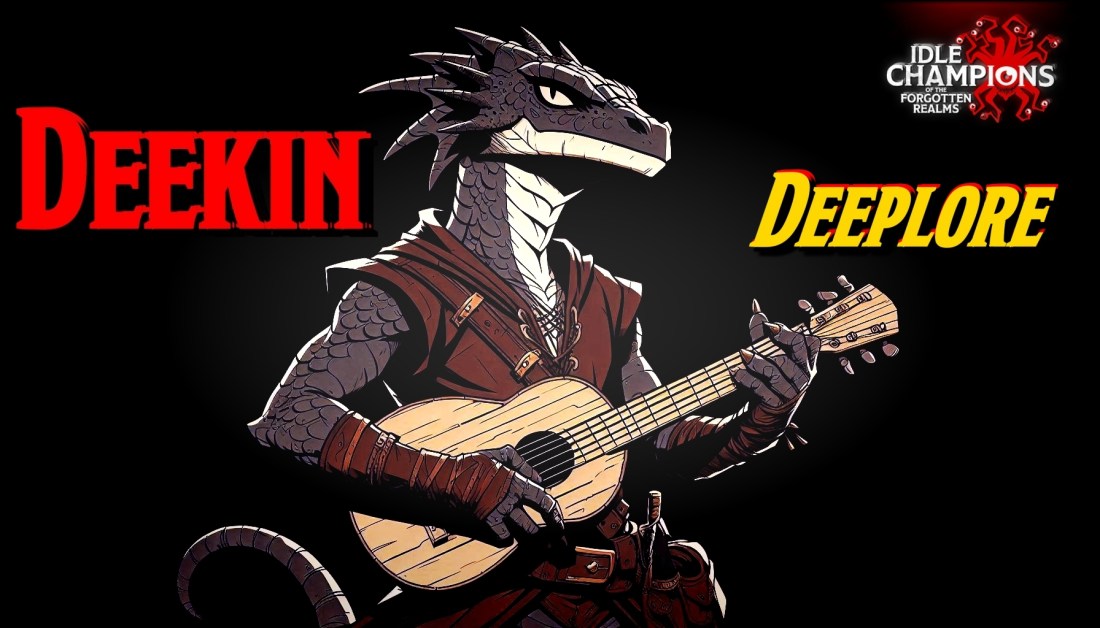
Deekin Scalesinger – a kobold bard with trembling scales, a quavering voice, and a heart that refuses to shrink to match his size. To many, he appears as comic relief: anxious, excitable, forever teetering on the edge of panic. A creature who shouts “Doom!” with such earnestness that it almost sounds like prophecy. But Deekin is not a joke.
He is a spark.
He does not dominate the battlefield through strength or spellcraft. He shapes its tempo through emotion. He does not command through authority. He commands through belief. And in a formation filled with giants, gods, and legends, it is the smallest voice that often pushes the story forward.
To understand Deekin, one must remember where he began. In Neverwinter Nights: Shadows of Undrentide, he first appears not as a warrior, but as a companion – nervous, earnest, and endlessly curious. Kobolds in the Forgotten Realms are fragile, numerous, and easily overlooked. They survive through traps, tunnels, and fear.
Deekin survives through narrative.
He attaches himself to heroes not because he expects protection, but because he is drawn to greatness. He believes in stories – dangerous ones, heroic ones, the kind that reshape the world. And he believes, with stubborn sincerity, that even a kobold can matter if he stands close enough to the moment where legends are forged.
He does not slow the world down. He urges it onward. He does not make the party safer. He makes the moment sharper. He does not wait for the story to unfold. He leans into it.
Deekin’s signature ability, Story of Doom, is often misunderstood. A kobold shouting “Doom!” should be comedic. And yet, somehow, those beside him grow stronger. Mechanically, it is adjacency-based buffing. Narratively, it is something deeper:
Deekin believes what he says.
When he cries “Doom!”, he is not performing. He is reacting. He feels the danger, the fragility of the moment, the sense that everything could collapse if the party hesitates. And because he feels it so intensely, those near him feel it too.
His urgency is not calculated.
His panic is not strategy.
His drama is not performance.
It is honesty – raw, unfiltered, unpolished.
And that honesty becomes strength. A routine encounter suddenly feels like a final stand. A simple skirmish becomes a moment that demands everything. Deekin does not reframe the battlefield with cold intention. He reframes it because his heart is convinced the world might end – and because he refuses to let it end quietly.
Heroes rise when someone beside them trembles and still chooses to sing.
This is not a global aura. It is not the voice of a commander shouting from afar.
Deekin inspires through closeness.
His power works best when someone stands shoulder to shoulder with him – close enough to hear the tremor in his voice, close enough to feel the urgency radiating off him, close enough to understand that his fear is real and his courage is, too.
He does not lead from a throne – he supports.
Deekin stands between heroes, small and shaking, and reminds them that the moment matters. His presence is not imposing. It is grounding. His fear does not weaken the party. It focuses them.
He does not mask his fear behind bravado. That transparency is what makes him trustworthy.
He is not the hero of the tale. He is the one who convinces the heroes that the tale is worth fighting for.
Then there is Confidence in the Boss, the ability that increases enemy spawns. On paper, it seems reckless. Why would anyone invite more danger? But Deekin’s logic is not the logic of a tactician. It is the logic of someone who grew up in a world where safety was never guaranteed.
For a kobold, danger is not escalation. It is the baseline. Tunnels collapse. Dragons pass overhead. Adventurers wander in with torches and steel.
Threats are constant, unpredictable, and rarely fair. Deekin does not see more enemies as a worsening situation. He sees it as honesty – the world revealing itself without pretense.
He does not escalate the threat. He recognizes it.
And in recognizing it, he accelerates the confrontation. If the world is going to test the party, better it test them now – while they are together, while they are ready, while the story still has breath.
This is not nihilism. It is courage sharpened by experience.
What makes Deekin compelling is not that he is powerful. It is that he is aware. He knows how small he is. He knows how fragile kobolds are. He knows how easily heroes fall. And yet he steps into formation anyway.
He does not try to become a dragon.
He does not try to become a legend.
He tries to make the moment matter.
He does not promise victory.
He promises significance.
And that is often the greater gift. In a roster filled with divine avatars and reality-bending spellcasters, Deekin reminds us that greatness is not measured in size or strength, but in the willingness to stand at the edge of doom and raise your voice anyway.
In the end, Deekin Scalesinger is not defined by his size, his fear, or even his cry of “Doom!” He is defined by the way he transforms that fear into momentum. He is defined by the way he stands close enough for others to feel his trembling – and close enough for them to draw strength from it.
He does not sing because the world is safe.
He sings because it is not.
He sings because someone must.
He sings because stories deserve witnesses.
And in singing at the edge of doom, he turns that doom into the very thing that drives the party forward.
 The Dystopian Inn