

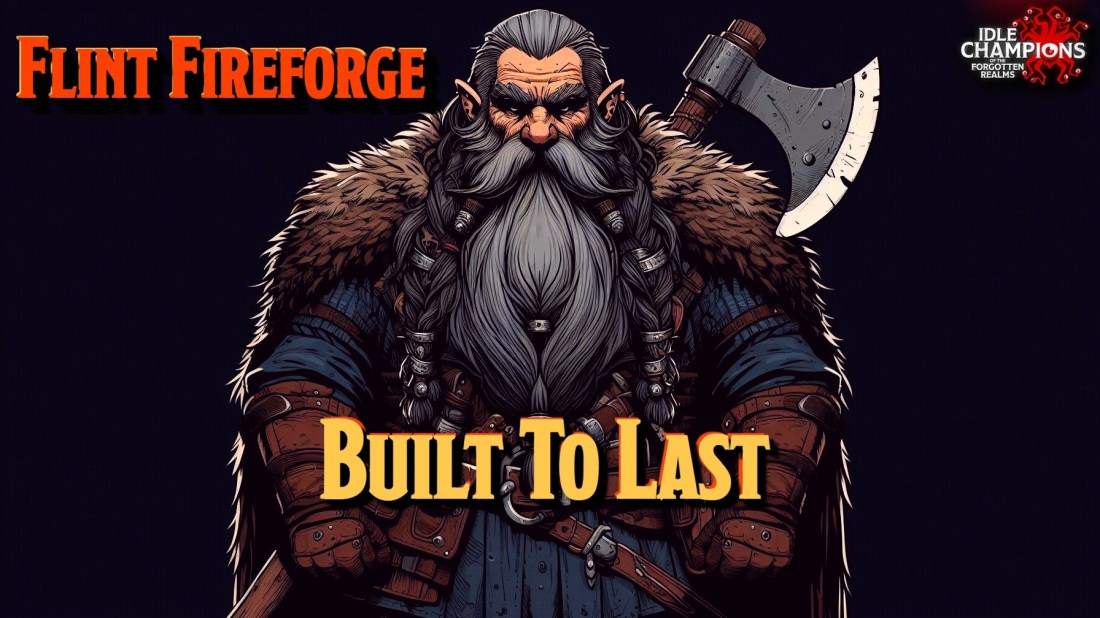
Flint Fireforge is one of Dragonlance’s most quietly enduring figures – a dwarf whose presence shapes the emotional landscape of the Companions not through grand gestures, but through steadfast loyalty, grounded wisdom, and the stubborn dignity of a craftsman who has seen the world change faster than he ever wished it to.
His story is not one of prophecy or divine calling. It is the story of a dwarf who chose his own family, carried his age with both pride and fear, and stood firm when others faltered.
Flint’s origins lie among the hill dwarves, yet he never fully embraced the insularity of dwarven tradition. He respected the craft, the discipline, and the heritage of his people, but he did not let those traditions confine him. Solace became his home – not by accident, but by choice. His forge there was more than a workplace; it was a sanctuary where he shaped metal with the same care he applied to shaping his life. Flint’s craftsmanship is central to his identity, and it reflects his worldview: the belief that things should be built to last, that effort matters, and that the world is held together by those who repair what others break.
It is in Solace that Flint’s life intersects with Tanis Half‑Elven, a young child found wandering alone in the forest. Flint takes him in, teaches him the discipline of metalwork, and offers him a place where he belongs. Their relationship is never explicitly labeled in the canon, but many readers interpret it as a father‑son bond – or at least the closest thing Flint ever has to one. Their connection is built on shared work and quiet understanding rather than overt sentiment. Tanis’s struggle with identity resonates with Flint’s own sense of displacement, and the dwarf’s protective instincts toward him reveal a vulnerability Flint rarely shows to others.
If Tanis represents Flint’s grounded, paternal side, Tasslehoff Burrfoot represents the opposite: chaos, curiosity, and the unpredictable joy of life. Flint’s exasperation with Tas is one of Dragonlance’s most recognizable dynamics. Tas steals his belongings, drags him into trouble, and tests his patience at every turn. Yet beneath the grumbling lies genuine affection. Flint’s protectiveness toward Tas is unmistakable, even if he hides it behind complaints. Their friendship becomes one of the emotional anchors of the saga, culminating in Flint’s quiet death on the slopes of Mount Nevermind – a moment witnessed only by Tas, whose grief underscores how deeply the dwarf had shaped his life.
Flint’s age is one of the most important themes of his arc. For a dwarf, he is not extraordinarily old – merely in the later stages of a long life. But Flint feels his age more keenly than many of his kin. His joints ache, his breath shortens, and he worries that he cannot keep pace with the younger Companions. This fear is psychological as much as physical. Flint is not terrified of death; he is terrified of becoming irrelevant, of failing those he loves, of being left behind. His awareness of his own mortality gives his journey a quiet poignancy that contrasts with the grand destinies of others.
Flint’s role in the Companions’ adventures is often understated, yet consistently meaningful. At Xak Tsaroth, he stands alongside Tanis, Sturm, Goldmoon, and the others as they confront the first great revelations of the War of the Lance. His practical caution tempers the group’s impulsiveness, and his grounded perspective helps them navigate the ruins without succumbing to fear or confusion. At Pax Tharkas, Flint’s reliability becomes essential. He is not the one who rallies armies or negotiates alliances, but he is the one who keeps the group moving, who repairs what breaks, who steadies those who falter.
His involvement in the search for the Disks of Mishakal further illustrates his importance. Flint is not driven by religious fervor or prophetic destiny, yet he recognizes the significance of the quest. His loyalty to his friends – especially Tanis – keeps him committed even when the path grows dangerous. Flint’s courage is quiet, but it is unwavering.
Not all of Flint’s contributions are solemn. His deep and abiding hatred of boats is one of Dragonlance’s most enduring sources of humor. Flint despises water travel with a passion that borders on mythic. He becomes seasick at the slightest motion, complains loudly, and blames boats for every misfortune. His aversion to flying devices is equally intense. When confronted with gnomish inventions – especially those of Mount Nevermind – Flint’s patience evaporates entirely. His distrust of gnomish engineering is not unfounded, and his reactions provide levity in moments of tension. These quirks are not mere comedic relief; they reveal Flint’s desire for stability in a world that increasingly defies his expectations.
Flint’s relationships with the other Companions deepen this portrait. He respects Sturm Brightblade’s honor, though he occasionally bristles at Sturm’s rigidity. With Caramon Majere, Flint finds a kindred spirit in practicality and good nature. Raistlin, however, evokes caution. Flint senses the mage’s ambition and secrecy, and while he rarely confronts him directly, his instincts are often correct. Goldmoon and Riverwind inspire in Flint a quiet respect. Their dignity and devotion reinforce his belief that the world is larger than Solace, larger than dwarven tradition, larger even than his own fears. Laurana’s transformation from sheltered princess to hardened leader is something Flint observes with a mixture of pride and protective concern. Her growth mirrors Tanis’s struggles, and Flint feels both admiration and worry as she steps into a role that demands sacrifice and steel.
Flint’s journey embodies several of Dragonlance’s central themes. He represents the dignity of ordinary heroism – the idea that one does not need prophecy or divine favor to shape the world. His arc is a meditation on aging, on the fear of becoming irrelevant, and on the courage required to face one’s own limits. His relationships illustrate the power of found family, the bonds forged not by blood but by choice. And his craftsmanship symbolizes the act of shaping one’s own destiny, one careful strike at a time.
His death is one of the saga’s most poignant moments precisely because it is quiet. Flint does not fall in battle or perish in a blaze of glory. He dies of the simple limits of his mortal body, sitting beside a friend who loves him. It is a passing that reflects his life: humble, honest, and deeply felt. Tas’s grief becomes the echo of Flint’s legacy – a reminder that even the smallest forge can shape the fate of the world.
Flint never slew the greatest dragon, never wielded divine power, and never sought glory. Yet whenever the Companions needed reminding of home, of friendship, and of the ordinary lives worth protecting, it was often Flint who provided that anchor. Even in the darkest moments, Flint rarely abandoned his habit of complaining – perhaps because grumbling was simply another way of caring.
His legacy is not one of legend, but of loyalty – and perhaps that is why it endures.

