

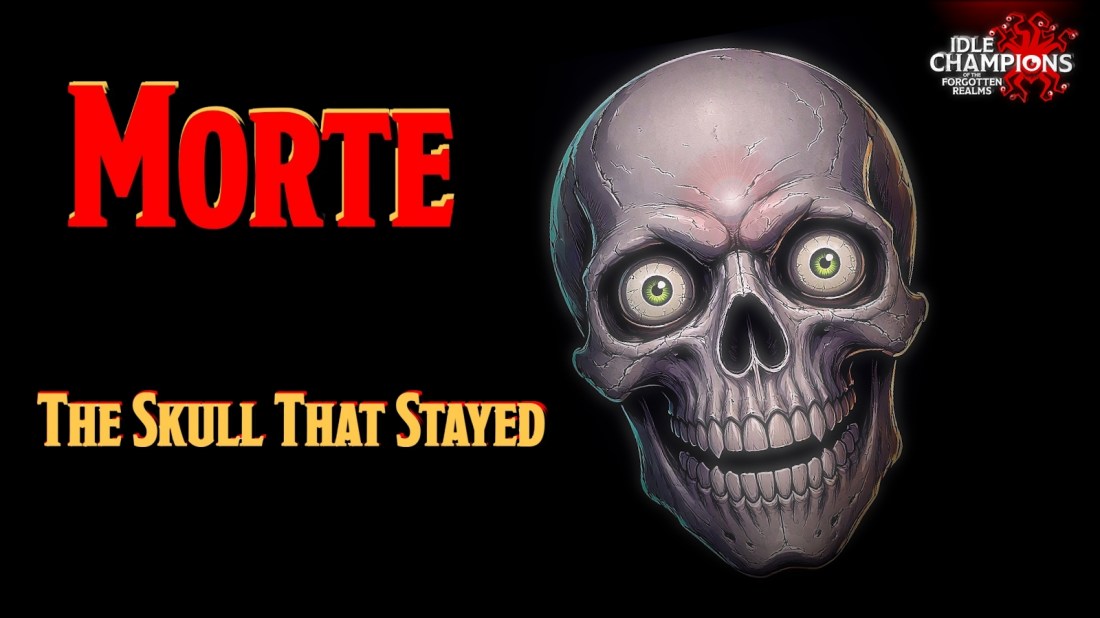
Morte – known in the original Planescape: Torment design documents as Mortimer “Morte” Rictusgrin -enters the story as a joke. A floating skull with a voice that never stops, a grin carved into bone, and a personality that seems designed to irritate anyone within earshot. It is easy to dismiss him in those first moments. He talks too much, he jokes too often, and he seems to treat the Nameless One’s awakening in the Mortuary as if it were a minor inconvenience. But that first impression is a mask, and like all masks in Planescape, it hides something older, darker, and far more complicated.
He is the first companion the Nameless One meets, and that alone gives him a unique place in the story. Morte is the one who explains the rules of the world, the one who pushes the Nameless One forward, the one who refuses to let him sink back into confusion. He acts like a guide, but he never calls himself one. He acts like a caretaker, but he never admits it. He acts like a friend, but he never uses the word. Morte’s entire identity is built on deflection. He hides sincerity behind sarcasm, fear behind bravado, and guilt behind humor.
That guilt is the core of him. Morte is not simply a skull who happened to be in the Mortuary. He is a liar who once served a power he should never have served. He is a coward who betrayed others to save himself. He is someone who carries the weight of past choices so heavy that he cannot bear to speak of them directly. His jokes are armor. His chatter is a shield. His constant commentary is a way to keep the silence away, because silence means remembering.
The Nameless One does not know any of this at first. He sees only the surface: a skull with a sharp tongue and a questionable sense of self‑preservation. But Morte stays with him. He stays through the Mortuary, through the Hive, through the alleys and the dust and the danger. He stays even when he complains. He stays even when he warns that everything is a bad idea. He stays because he is afraid of being alone again, and because the Nameless One represents something he has not had in a very long time: a chance to do better.
Their relationship is strange. The Nameless One is a being of shifting identities, fragmented memories, and endless reincarnations. Morte is constant. He remembers everything. He remembers every version of the Nameless One, every mistake, every cruelty, every moment of weakness. He remembers the past that the Nameless One cannot access. And that memory is both a burden and a bond. Morte knows the worst parts of the Nameless One, and he stays anyway. That is loyalty of a kind that does not fit neatly into heroic stories.
There are moments when Morte’s facade cracks. When he speaks with more sincerity than he intends. When he shows fear that is not exaggerated for comedic effect. When he reveals pieces of his past that he would rather keep buried. These moments are rare, but they define him more than any joke ever could. Morte is not fearless. He is terrified. He is not brave. He is desperate. He is not loyal by nature. He is loyal because he has learned what happens when he is not.
One of the most important turning points for Morte comes when the truth of his past finally surfaces. He once served the Pillar of Skulls, a grotesque monument of suffering and knowledge. He was part of it. He was bound to it. And he escaped by betraying others. That betrayal is the reason he is free, the reason he can float beside the Nameless One, the reason he can speak and joke and complain. It is also the reason he fears being found again. The Pillar remembers. The Pillar does not forgive.
When the Nameless One confronts this truth, Morte expects rejection. He expects anger. He expects punishment. Instead, he receives something else: understanding. The Nameless One has lived long enough, suffered long enough, and lost enough pieces of himself to recognize what guilt looks like. He does not excuse Morte’s past, but he does not abandon him for it. That moment reshapes their relationship. Morte’s loyalty becomes less about fear and more about choice. He stays not because he is afraid of being alone, but because he wants to stand beside someone who sees him clearly and does not turn away.
Morte’s interactions with other companions reveal different sides of him. With Annah, he is teasing, sometimes cruel, sometimes protective. He mocks her accent, her temper, her suspicion, but he also respects her strength. With Dak’kon, he is wary. Dak’kon’s calm, disciplined presence contrasts sharply with Morte’s chaotic energy, and Morte often tries to provoke him just to see if he can break that composure. With Fall‑from‑Grace, he is flustered. Her serenity disarms him, her kindness confuses him, and her ability to see through his jokes unsettles him more than he admits.
And then there is Nordom. The little modron who sees the world in terms of logic and parameters. Morte’s relationship with Nordom is unexpectedly gentle. He teaches Nordom how to insult people, how to joke, how to express personality. It is one of the few times Morte acts as a mentor without hiding behind sarcasm. He sees something of himself in Nordom: a being who does not quite fit the rules of the world, who is trying to understand emotions he was not built to have. Their bond is quiet, but meaningful.
Morte’s development is not a straight line. He does not become noble. He does not become selfless. He does not transform into a hero. What he becomes is honest. He learns to speak truths he once avoided. He learns to admit fear without disguising it. He learns to stand beside the Nameless One not because he must, but because he chooses to. His jokes remain, but they lose their edge. His sarcasm remains, but it becomes less defensive. His chatter remains, but it carries more sincerity.
The final confrontation in the Fortress of Regrets crystallizes everything. Morte faces the consequences of his past, the weight of his guilt, and the fear of losing the Nameless One. He does not run. He does not hide. He does not deflect. He stands his ground. For a character built on avoidance, that moment is a quiet triumph. It is not grand. It is not dramatic. It is simply honest.
Morte’s story is not about redemption in the traditional sense. It is about the slow, painful process of accepting who you are and choosing to be better anyway. It is about loyalty that grows from fear into trust. It is about humor used as armor until the moment comes when armor is no longer needed. It is about a skull who talks too much, jokes too often, and cares far more than he ever intended.
He begins as a joke. He ends as a companion. And somewhere in between, he becomes something rare: a character whose flaws are not erased, but understood. A character whose past is not forgiven, but faced. A character whose loyalty is not assumed, but earned.
Morte floats because he has no body. He speaks because silence is dangerous. He stays because he has learned, slowly and painfully, that staying matters. And in the strange, shifting world of Planescape, that is enough to make him unforgettable.

