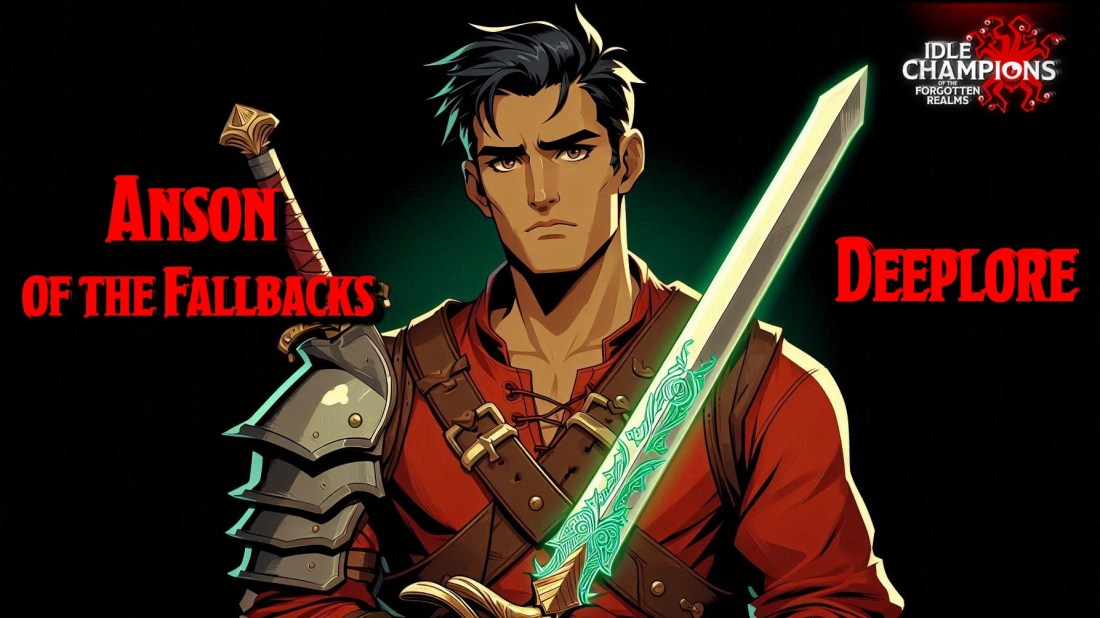
D&D Deeplore: Anson – A Reluctant Hero


People often say Anson sees things early. What they don’t mention is that he sometimes speaks too soon. There’s a particular silence that follows when he points out a problem no one else has noticed yet – a silence that feels less like gratitude and more like the room quietly wishing he had waited. That tension clings to him, even when he’s right. Especially when he’s right.

Where He Comes From

Anson’s home was small, unremarkable, and perpetually on the edge of something – not disaster, not prosperity, just the slow, grinding uncertainty that makes every decision feel heavier than it should. The dangers there weren’t dramatic. They were cumulative. A bad harvest. A broken tool. A promise made too quickly. Nothing that would ever make it into a bard’s song, but everything that could quietly ruin a family.

In such a place, you learn to watch. Not because you’re gifted, but because the cost of not watching is immediate. Anson learned to track the small shifts: a neighbor who stopped talking as much, a merchant who changed their route, a storm that arrived half a day earlier than expected. He didn’t think of it as a skill. It was simply how you survived.

But there’s a side effect to that kind of vigilance. You start seeing patterns everywhere – even when you wish you didn’t. You start anticipating outcomes before anyone else has even realized there’s a choice to be made. And you start carrying the weight of those outcomes long before they happen.

That weight shaped him more than the place itself.

Why He Left

Leaving wasn’t a dramatic moment. No argument, no tragedy, no revelation. Just a slow accumulation of small truths. He realized he wasn’t solving problems anymore – he was delaying them. Holding things together long enough for the collapse to look orderly. And the more he tried to help, the more he felt like he was becoming part of the machinery that kept the place stuck.

So he left. Quietly. Predictably. Almost mathematically.

On the road, he didn’t reinvent himself. He didn’t seek adventure. He took work that required reliability, not charisma. He listened more than he spoke. He avoided people who believed too strongly in destiny. He trusted patterns, not promises.

And then he met the Fallbacks.

Who the Fallbacks Are

The Fallbacks are not the first choice for anything. They’re the group you call when your original plan fails, when the obvious heroes are unavailable, uninterested, or already dead. They operate in the aftermath of better ideas.

What makes them compelling is not their competence – though they have plenty of it – but their honesty. They don’t pretend to be saviors. They don’t chase glory. They solve problems because someone has to, and because they’re willing to accept that the solutions won’t be clean.

They are improvisers, specialists, pragmatists. People who understand that success often means choosing the least damaging option. People who know that sometimes the best outcome is simply preventing things from getting worse.

Anson recognized that immediately. It felt familiar.

How He Joined Them

The moment Anson became part of the Fallbacks wasn’t marked by heroism. It was marked by a miscalculation – not his, but theirs. A caravan escort job that should have been simple turned complicated fast. The bandits were better organized than expected. The terrain offered fewer advantages than the Fallbacks had assumed. Panic spread through the caravan workers. Arguments broke out among the Fallbacks themselves.

Anson didn’t take charge. He didn’t shout instructions. He simply pointed out a constraint no one else had accounted for – a detail about timing, terrain, and the bandits’ formation. It wasn’t brilliant. It was just the missing piece that made the rest of the plan coherent.

The solution that followed wasn’t elegant, but it worked. More importantly, it avoided a cost the others had been willing to pay too easily.

Afterward, no one asked him to join. They just started talking to him as if he already had.

His Role Within the Group

Within the Fallbacks, Anson occupies a strange space. He is not the leader, but his assessments often shape decisions. He doesn’t command, but his silence can stop a plan mid‑stride. He sees patterns forming before others feel their weight, and that makes him both valuable and unsettling.

He doesn’t believe in clean victories. He believes in survivable outcomes. That distinction matters, because it forces choices no one wants to own. Someone has to decide when to retreat. Someone has to say that a partial success is better than a glorious failure. Anson often becomes that someone – not because he wants to, but because he sees the alternatives too clearly to pretend otherwise.

But clarity is not the same as certainty.

His Flaws and Blind Spots

Anson’s perception is sharp, but not infallible. He reads situations well, but people are not situations. Motives are not patterns. And sometimes his caution becomes hesitation.

There are moments when decisions are made while he is still calculating the cost. Moments when instinct or conviction pushes the Fallbacks forward while he holds back, convinced the risk is too high. Sometimes he’s right. Sometimes he’s wrong. The difference is rarely obvious in the moment.

What isolates him is not being wrong – it’s knowing he might be. He carries responsibility like a reflex, even when no one asks him to. When a plan fails after he warned against it, he feels the weight of having seen it and not stopped it. When a plan succeeds by ignoring his caution, he wonders whether his entire worldview – built on restraint and risk management – is narrower than he wants to admit.

He doesn’t talk about this. He just adjusts, quietly, as if recalibrating himself.

Why He Stays

Despite the discomfort, despite the uncertainty, Anson stays with the Fallbacks. Not because he believes in destiny or heroism, but because he recognizes something rare: a group that understands its own limitations. The Fallbacks don’t pretend to be more than they are. They don’t hide their doubts. They don’t chase illusions of perfection.

They operate in the cracks of the world – the same cracks Anson has lived in his entire life.

He stays because leaving again would mean abandoning not a collapsing settlement, but a group that functions precisely because it acknowledges the cost of every choice.

Why He Matters

Anson is not the hero who changes the world. He is the one who prevents it from unraveling a little faster than it otherwise would. His strength is not dramatic, and his flaws are not theatrical. He is compelling because he embodies a kind of heroism that rarely gets celebrated: the quiet, persistent effort to keep things from getting worse.

But if you asked him whether that’s enough, he wouldn’t answer. Not because he’s evasive, but because he genuinely doesn’t know.

Maybe this is the only way he knows how to exist in the world.
Maybe this is the only place where his way of seeing things isn’t a burden.
Or maybe – and this thought lingers longer than he likes – he stays because he has no idea what he would become if he stopped watching for the next small thing that might go wrong.
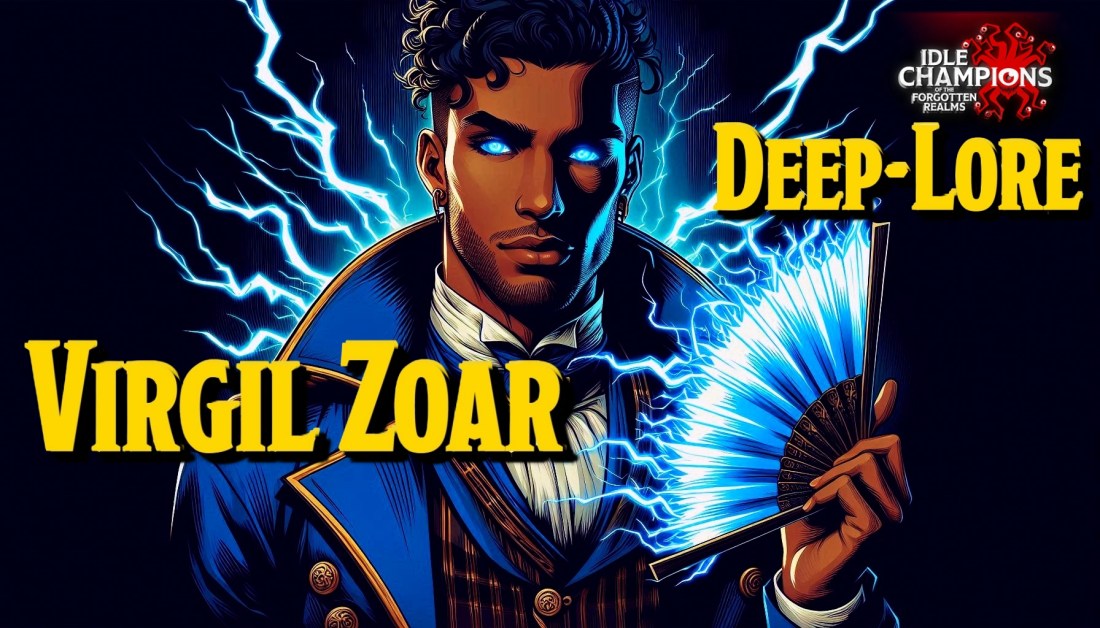
D&D Deep Lore: Virgil

Not all storms rage. Some whisper. Some wait. And some wear silk gloves while holding lightning (and a fan). In this Deep Lore, we follow Virgil Zoar – storm sorcerer, Aasimar, and quiet tactician of the Rivals of Waterdeep. Where Kent dances with ghosts, Virgil listens to the wind. Where others seek glory, he seeks equilibrium.

Born under open skies and shaped by restraint, Virgil is not the hero of tavern songs: he is the pause before thunder. The breath held between grief and grace. And beside him, always, Kent – the spark in the eye of the storm. Together they do not save each other. They simply refuse to let the other vanish. This is not just a story of magic and mechanics. It is a study in patience, in clarity, in the art of holding emotion gently.

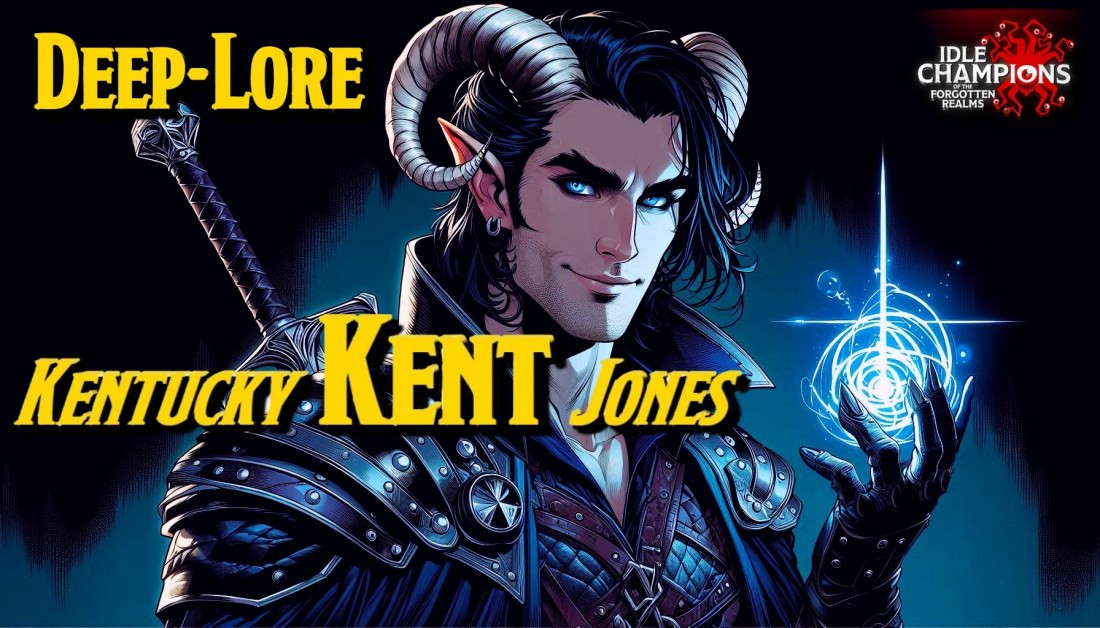
D&D Deep Lore: Kent

Welcome back to the Dystopian Inn, traveler. Tonight’s tale is not about glory, nor vengeance, nor destiny. It’s about Kent – a Tiefling rogue, flamboyant scholar, and one of the most quietly tragic figures in Idle Champions of the Forgotten Realms.


Kentucky “Kent” Jones, archaeologist by passion, survivor by necessity, once chased knowledge into the ruins of Talona’s temple. He emerged alone. His team did not. Caradoon saw a hero. Kent saw ghosts. And he’s been trying to justify his survival ever since.
This Deep Lore explores the man behind the charm: the sleepless nights, the weight of memory, and the rituals of remembrance that shape his every move. From “Tokens of the Departed” to “Wails from the Grave,” Kent’s abilities aren’t just mechanics – they’re echoes of the past, turned into power.
And then there’s Virgil. The quiet storm to Kent’s restless flame. Together, they form the Rivals of Waterdeep – not by fate, but by understanding.
Where Kent burns, Virgil grounds. Where Kent falters, Virgil steadies.

Kent isn’t a hero. He’s not a villain. He’s a man who made it out when others didn’t. And every joke, every blade flicked with theatrical precision, is his way of remembering differently.

So when you see Kent in Idle Champions, don’t just see a Rogue with spectral flair. Listen. You might hear the whisper of something older.
Something human. A scholar’s mind, burdened by ghosts.

Next time, we follow Virgil into the skies. But for now, settle in. The past deserves to be known.

Idle Champions: Reworked Havilar With some mishaps.

Havilar has been reworked, and it’s time to put her to the test-starting with Variant 1: “Odd Ones Out.” With half the bench slots locked and only the Brimstone Angels allowed to break the rules, it’s a challenge that demands creativity, patience, and a bit of family bonding. Havilar, Farideh, and Mehen step up, but low item levels and missing DPS make things… interesting.

From the very first setup, mishaps abound: champions in the wrong slots, BUD-setting bouncing between Kent, Farideh, and Durge, and Evelyn tanking like a champ while Jarlaxle dies on impact. The server lags, Vi’s Sass-stacks fall behind, and the Faithful Friend slot seems to have a mind of its own. But through it all, Havilar holds the line-buffing from the front, summoning imps, and stacking Leadership Summit like a true infernal tactician.
As the run pushes toward Area 1200 and beyond, the formation shifts, the gold climbs, and the Brimstone Angels rally. It’s not smooth, it’s not elegant, but it’s effective. By the end, Variant 1 is cleared, Havilar gains 300 item levels, and seven gold chests are earned-along with a healthy dose of disbelief that it actually worked.
Now, with Variant 2 looming and Diamond Golems waiting to be tanked, it’s time to let the game run overnight and hope the server holds. Havilar may be young, but she’s already proving she can carry a team-even if that team is missing half its seats.

Oh, and that Havilar-Spotlight-Video – you can find it here:

Something Wicked This Way Comes: Skylla Spotlight

A new force enters Idle Champions on November 5th 2025 – her name is Skylla, and she borrows powers from Baba Yaga herself. Seat 4 Warlock, Support & Debuff, her whispers twist the battlefield and her fire punishes the unwise.

Watch her Spotlight right here:

In the annals of Dungeons & Dragons, where countless names flicker like candles lost to history, only a few villains burn bright enough to cast shadows across ages. Skylla is one of them. A warlock whose ascent began in the earliest days of the game, she embodies an older, darker style of fantasy-where ambition is sharper than any dagger, and the pursuit of power leaves no room for apology.

Skylla’s story begins long before she was feared. Born in a world that would later be known as Mystara, she was marked from childhood by a relentless intellect. Magic came to her like breathing, and though others celebrated wonder, she questioned limits. Motion, power, destiny-she sensed that arcane law existed only to be rewritten.

When she reached adulthood, Skylla joined a fellowship of adventurers. Among them stood Warduke, the infamous black-armored warrior whose legend would rise alongside-and then against-her own. Steel and spell stood united in those early days. The company fought horror and chaos together, guided by youthful dreams of glory.

But unity hides fractures. Skylla’s companions saw their missions as acts of heroism. She saw them as squandered opportunities. They sealed dark vaults when she wished to learn what secrets lay inside. They destroyed relics of power, blind to the potential she alone recognized. In every triumph she felt a loss. Their ideals became her chains.

And then came the turning point that severed her from the path of heroes.

Some tales whisper she struck a bargain with a demon. Others say she stole forbidden knowledge. But the truth-newly revealed in modern chronicles-speaks a more chilling name: Baba Yaga, the Mother of Witches herself. From that infamous arch-hag, Skylla drew terrible power. Feywild trickery and unpredictable magic infused her spells, shaping her into a warlock whose craft bent minds, distorted the battlefield, and revealed weakness where others saw courage.

Her companions recoiled. Warduke’s blade was the first drawn against her. And in that single moment, trust shattered. Skylla was cast out, condemned as traitor.

Exile did not break her. It refined her.

Where heroes sought honor, Skylla sought results. She found sanctuary among the League of Malevolence-a gathering of villains who valued strength above sentiment. But even then, she stood apart. Allies, as she saw them, were merely instruments. Useful while they played her tune. Disposable once they fell out of step.

While others schemed for coin or conquest, Skylla’s ambition fixed itself on something greater: legacy.

She mastered warlock invocations that lured foes into illusion, tangled their minds in hypnotic patterns, and painted their silhouettes in faerie-fire brilliance-marks of doom for any who opposed her. Her magic was less about raw destruction and more about humiliating control. She broke willpower before she broke bodies.

Warduke, too, rose in power. Yet his infamy was a blade forged from rage. Skylla’s was crafted from intellect. Their rivalry became legend-two former allies battling not just for dominance, but for the story itself. She believed he had stolen the life she deserved, leaving her to be remembered only as the exile. He believed she had betrayed them all. So they clashed again and again, their hatred written into every strike and spell.

But Skylla’s heart holds no nostalgia.

Where others cling to lost friendship, she looks only forward. Her eyes are fixed on a throne no one else imagines.

And it is this unyielding conviction that defines her true power.

Skylla’s magic draws from chaos, misdirection, and the fear that grows in silence. Her enemies underestimate her-often fatally. She does not shout like warlords or roar like dragons. She whispers. She smirks. She watches her foes scramble against their own illusions while she prepares their downfall.

The League of Malevolence knows this well. They respect her because they must. They know that should they falter, Skylla will be the first to strike, to step over their failures without pause. But as long as they serve her schemes, they are safe-relatively. Power, to Skylla, is an equation. And she has always been good with numbers.

In a wider sense, Skylla is a relic reborn. When the world of Dungeons & Dragons shifted focus to new realms and new heroes, many early villains faded into obscurity. Skylla refused to vanish. Through various editions, through nostalgic revivals, through re-imagined roles in digital adventures, she remained-a reminder of the ruthless storytelling that shaped the game’s foundation.

What makes her so compelling is that she is not evil without cause. She is ambition given voice. She is genius without restraint. She is what happens when the world punishes brilliance rather than nurturing it.

Her philosophy, spoken through actions more than words:

Why ask permission to seize greatness? Why bow to lesser minds simply to appear heroic? If the world rejects you-rewrite the world.

Some would say she envies Warduke’s fame. Skylla would answer: fame is merely applause. Power is permanence. She intends to be remembered not as a rumor, but as a rule.

There are whispers, even now, that she seeks more gifts from her patron. That she studies ways to twist immortality as a tool-not to cling to existence, but to ensure that every age must reckon with her name. If she succeeds, the League of Malevolence may become a footnote in her saga. Warduke may become nothing more than a warning.

Every spellbook she fills, every pact she deepens, every rival she crushes is just another step. Skylla believes history will not ask whether she was right-only whether she prevailed. And she has no intention of losing.

Even the Feywild, with all its shimmering unpredictability, seems to bend uneasily around her. Illusions that once delighted faeries now serve as weapons of dominance. Enchantments crafted for mischief become instruments of terror. Chaos, to Skylla, is simply another element to be mastered.

Today, her red and shadowed garments remain an omen. Her emerald familiar-a sly, watchful companion-suggests her mind is always three moves ahead. When she walks into a room, the fearful do not ask what she wants. They ask when the price will come due.

There is beauty in her cruelty, some say. A terrible elegance. Skylla is not sloppy. She does not revel mindlessly in destruction. Every wicked act serves a purpose: to climb, to conquer, to continue.

And to ensure that no one will ever have the power to cast her out again.

In this, she is both a warning and a symbol. A warning that unchecked ambition scorches the soul. A symbol that even villains are forged from wounds that heroes choose not to see.

If she stands atop the world one day-and she believes she will-it will not be because fate favored her. It will be because she demanded it. Because she buried her past rather than being buried by it. Because she believed that greatness is seized, not granted.

Skylla is not the hero of this tale. But she is the force that drives tales to be told. When torches burn low and dice hit the table, when adventurers dare the darkness and delvers meet their doom, her shadow is never far. She is the ever-present reminder that in Dungeons & Dragons, villains are not accidents. They are choices. They are consequences.

And Skylla-Warlock of Baba Yaga, Mistress of Manipulation, Exile who rose higher than those who scorned her- she is consequence incarnate.