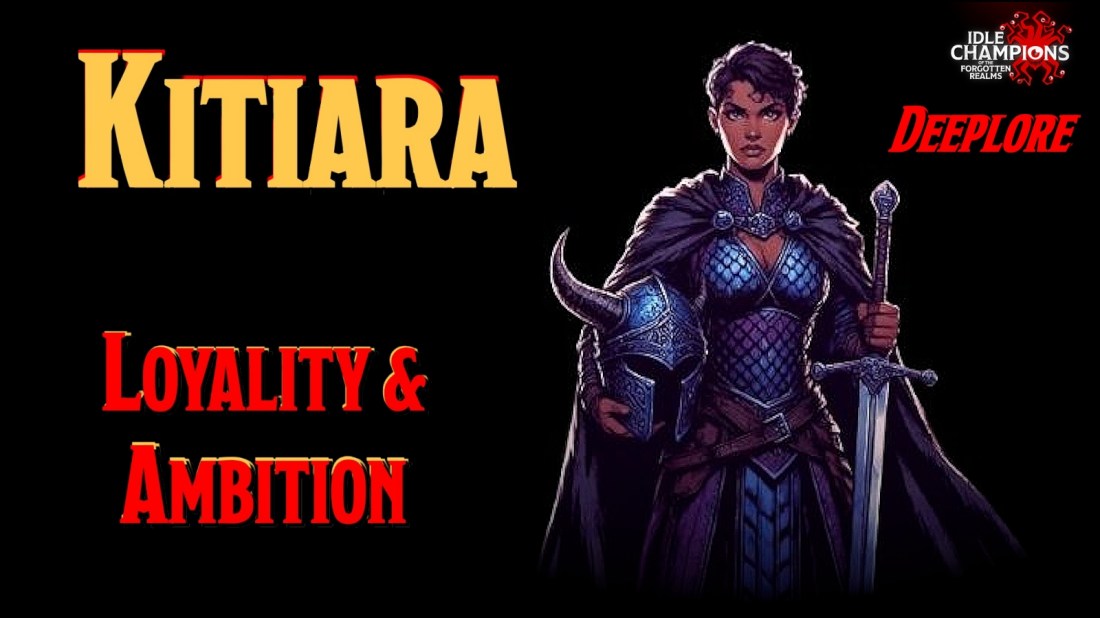
D&D Deeplore: Kitiara Uth Matar – Strength, Ambition and the Path She Carved

Will Kitiara Uth Matar make it into Idle Champions of the Forgotten Realms at Liar’s Night? This Deeplore looks at the choices that shaped her rise, the ambitions that drove her forward, and the consequences she never pretended were simple.

Kitiara Uth Matar has always lived in the narrow space between loyalty and ambition, and she has never tried to escape it. Strength and flaw come from the same source in her: a fierce independence that shapes every choice she makes.
She is driven by impulses that do not always align, and she has learned to live with that tension rather than resolve it. Those who know her understand she is neither simple nor predictable. Every decision carries weight, and she has never shied away from that weight.

Growing up alongside Caramon and Raistlin taught her early that the world rewards action, not potential. Caramon’s kindness made him vulnerable; Raistlin’s brilliance made him dangerous to underestimate. Kitiara saw that waiting for protection was a luxury she did not have. Independence became her default stance long before adulthood demanded it.

She stepped into responsibility because no one else would, and she never relinquished that habit. Her path as a mercenary was shaped by choices that could have ended her career before it began. Contracts others avoided became her opportunities.

She learned to judge quickly: which commander had real authority, which soldier would hold the line, which ally would break under pressure. Loyalty revealed itself as a layered thing. Some followed her out of respect, others out of fear, and others because she paid well. She never pretended otherwise. She did not demand loyalty; she managed it.

And she understood that loyalty built on ambition or fear can be just as effective as loyalty built on admiration. Kitiara’s charisma is sharp rather than warm. She listens closely, speaks precisely, and carries herself with a confidence that makes people assume she knows more than she says. She is not manipulative in the petty sense, but she uses her understanding of people to get what she needs. Flattery, threat, silence—each is a tool she wields with practiced ease.


Yet even she misjudges. Allies have surprised her; enemies have slipped past her guard. She carries those mistakes not as regrets but as reminders that clarity has limits.

Her relationships with her half‑brothers are shaped by history rather than sentiment:
With Caramon, she shares a familiarity forged in childhood, a recognition of shared origins even when their paths diverge. She respects his strength, though she sometimes overlooks the depth of his loyalty. With Raistlin, she shares something sharper: ambition. She recognizes in him a hunger that mirrors her own, though his is colder and more calculated. She does not assume she understands him completely, and he treats her with a wary acknowledgment. Their relationship is not warm, but it is grounded in a mutual understanding of what ambition can cost. They do not always speak honestly, but they see each other clearly.

Clarity is one of her defining traits, but also one of her greatest dangers. Patterns reveal themselves quickly to her; power dynamics make sense at a glance. She acts decisively, often correctly, sometimes too quickly. That decisiveness can harden into rigidity. She believes in strength, discipline, and purpose, but she can overlook the value of patience or compassion. Her certainty has led her into conflicts she might otherwise have avoided. The same blade that cuts through hesitation can cut allies as easily as enemies.

Commanding the Blue Dragonarmy is the culmination of everything she has built. It is not a destiny bestowed upon her; it is a position she carved out through competence and will. She leads with discipline and expects the same from those under her command. She is not cruel for cruelty’s sake, but she is willing to make sacrifices others hesitate to consider. Soldiers respect her, though some fear her, and she accepts both. Her alliance with dragons reflects the steadiness she brings to every encounter.

She respects their power without letting that respect become submission. Confidence is her shield, and dragons respond to it—even if their reasons remain their own. Few mortals can stand before a dragon without flinching; Kitiara stands as if she belongs there, even when she knows one misstep could mean death. One of the most defining choices of her life—joining the Dragonarmies—reveals her complexity more clearly than any personality trait. She did not join out of blind loyalty or ideological fervor. She joined because she saw an opportunity to rise, to command, to shape events rather than be shaped by them.

It was a decision that brought her power, but also conflict. It put her at odds with people she cared about and forced her to navigate loyalties that could not coexist peacefully. She justified the choice, but she did not pretend it was simple. It was a decision made with clear eyes, and she accepted the consequences even when they cut deeply. Kitiara does not seek redemption because she does not believe she needs it. She does not see herself as fallen or broken. She sees herself as someone who has made difficult choices in a difficult world.

But she is not blind to the effects of those choices. Ambition has shaped her relationships, her opportunities, and her reputation. Clarity has hardened into stubbornness. Independence has become isolation. She accepts these things not with pride, but with the same practicality that guides all her decisions. She justifies her choices, but she does not pretend they were costless. In battle, she is relentless. Purpose drives her movements; precision defines her strikes. Authority radiates from her presence. Yet she is not infallible. Confidence can lead her to underestimate an opponent. Decisiveness can make her commit too early. Ambition can push her into risks others avoid. She wins because she adapts quickly, not because she is perfect. And when she loses, she does not always learn the lesson others expect.

Sometimes she draws conclusions that reinforce her independence rather than soften her resolve. She folds each outcome into her understanding of the world and moves forward, even when the path ahead is steep. Beyond the battlefield, she navigates politics, alliances, and rivalries with the same tactical awareness she brings to war. Directness serves her well, but it can also be dangerous. She pushes hard, assumes much, and trusts selectively. Adaptable but not patient, resilient but not gentle, effective but not always right—her strength is real, but it is not effortless. It is something she maintains deliberately, sometimes at the expense of connection. Kitiara Uth Matar is not a hero in the traditional sense, nor is she a villain. She exists in the space between, a space she occupies with confidence and purpose. Experience, ambition, and an unwavering belief in her own capability shape her path. She is the kind of presence that does not need to be introduced; she announces herself simply by walking into the room. And once she is there, the room does not change because she demands it. It changes because she acts, and her actions have weight. She brings something different: a reminder that strength is complicated, ambition dangerous, and leadership rarely simple. She is built not from prophecy or divine favor, but from grit, discipline, and a lifetime of choices made with clear eyes. She is a warrior, a commander, and a presence that cannot be ignored. And when she steps into any story, she does so not as a symbol of hope or redemption, but as a testament to the power—and the cost—of carving one’s own path.
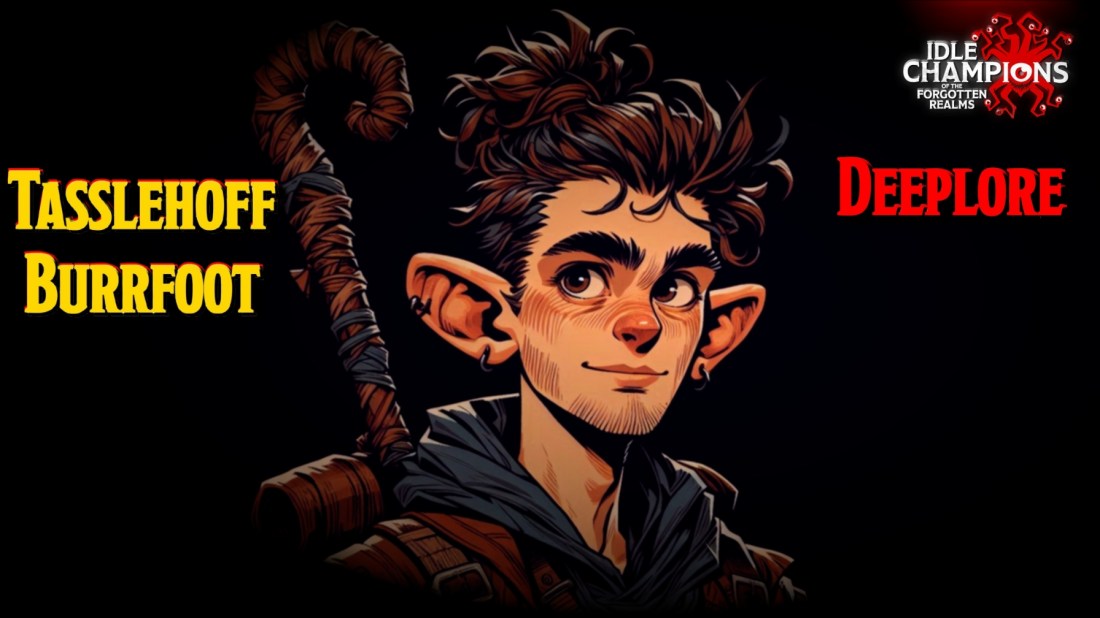
D&D Deeplore: Tasslehoff Burrfoot – Chaos That Shouldn’t Work (But Does)


Tasslehoff Burrfoot is one of the strangest success stories in all of Dragonlance. Not because he is powerful or wise, but because he is neither of those things and still manages to shape the world around him. Tasslehoff is a character who should not work, should not survive, should not matter – yet he does. His impact comes from something simple: Tasslehoff does not change the world by changing himself. He changes it by being impossible to ignore.

To understand Tasslehoff, you first have to understand what a kender is. Kender do not feel fear the way other races do. They do not treat danger as a warning. Threats are curiosities. A dragon becomes a creature worth talking to. A locked chest becomes a puzzle. A villain’s lair becomes a sightseeing opportunity. This is not courage. It is a missing instinct. And Tasslehoff Burrfoot embodies that missing instinct more than any other kender.

From the moment he appears, Tasslehoff treats the world like a playground. Traps attract him because they look interesting. Cursed artifacts end up in his hands because they seem lonely. Tense moments collapse because silence makes him restless. The result is not harmless mischief. Plans fall apart. Missions become harder. The group is forced to improvise again and again. Yet the same unpredictability that causes trouble also saves lives. Tasslehoff stumbles into solutions no one else would have found.

His chaos has structure. It exposes the truth about the people around him. Caramon’s protectiveness, Raistlin’s irritation, Flint’s reluctant affection, Tanis’s exhaustion – Tasslehoff brings all of it to the surface. He does not grow in the traditional sense, but he reveals the growth others need. Tasslehoff Burrfoot becomes the emotional stress test of the party. Fragile things break around him. Hidden things come to light. Not because he intends it, but because he cannot imagine a world where secrets stay secret.

Tasslehoff is more than a mirror. He is a contradiction in motion. Compassion drives him, but boundaries mean little to him. His desire to help often complicates situations before it improves them. He cares deeply about people, yet forgets that people can die. Innocence defines him, but that innocence carries risk. This tension gives him weight. He is not a mascot. He is a force that reshapes the story simply by existing.

His pockets say everything about him. They hold a broken buckle, a shiny stone, a key to a door no one remembers, a trinket he picked up because it looked sad. Most of it is useless. Some of it is dangerous. Occasionally, one of these objects becomes exactly what the party needs. Tasslehoff does not collect items. He collects possibilities. And possibilities rarely behave.

His relationships anchor him. Flint Fireforge scolds him constantly, yet watches over him with quiet loyalty. Caramon treats him like a younger brother who needs supervision. Raistlin studies him with a mix of irritation and curiosity. Tanis manages him with the patience of a tired parent. Laurana sees the good in him even when others lose patience. Tasslehoff does not fully understand these dynamics, but he feels them. His loyalty is absolute, even if his attention is not.

Loss touches him as well. Tasslehoff does not become grim or hardened. He does not turn into a darker version of himself. But he feels grief. He carries it differently. Instead of collapsing, he remembers. He talks about the people he has lost. He honors them by continuing to live with the same chaotic curiosity they once found exhausting. His resilience is quiet, but real.

Tasslehoff Burrfoot works because he breaks narrative rules without breaking the narrative. He is unpredictable without being pointless. Innocent without being naive. Chaotic without being destructive for destruction’s sake. He does not need a character arc because he functions as the arc. The world bends around him, reveals itself through him, and becomes more honest in his presence.

That brings us to Idle Champions of the Forgotten Realms. Tasslehoff is not in the game – at least not yet. His appearance is only an educated guess, a possibility circulating through the usual spoiler channels. If he ever joins the roster, he would stand out not because of raw strength, but because of how he interacts with the world.

Any mechanical ideas for him are speculation. But capturing Tasslehoff Burrfoot would require risk. A stolen item might grant a powerful buff after briefly lowering your damage. A rare effect could trivialize a boss or force you to adapt on the spot. A sudden shift in formation might disrupt your plan before rewarding you with a burst of power. These are not predictions. They are possibilities – the kind of unpredictable potential that fits a character who has never behaved predictably.

Tasslehoff Burrfoot is not a hero because he grows. He is a hero because he refuses to stop being himself, even when the world becomes darker than he understands. Chaos with heart. Curiosity with consequences. Innocence with impact. He should not work. Yet he does. And if he ever joins Idle Champions, he will bring exactly that energy with him – helpful, disastrous, and impossible to forget.

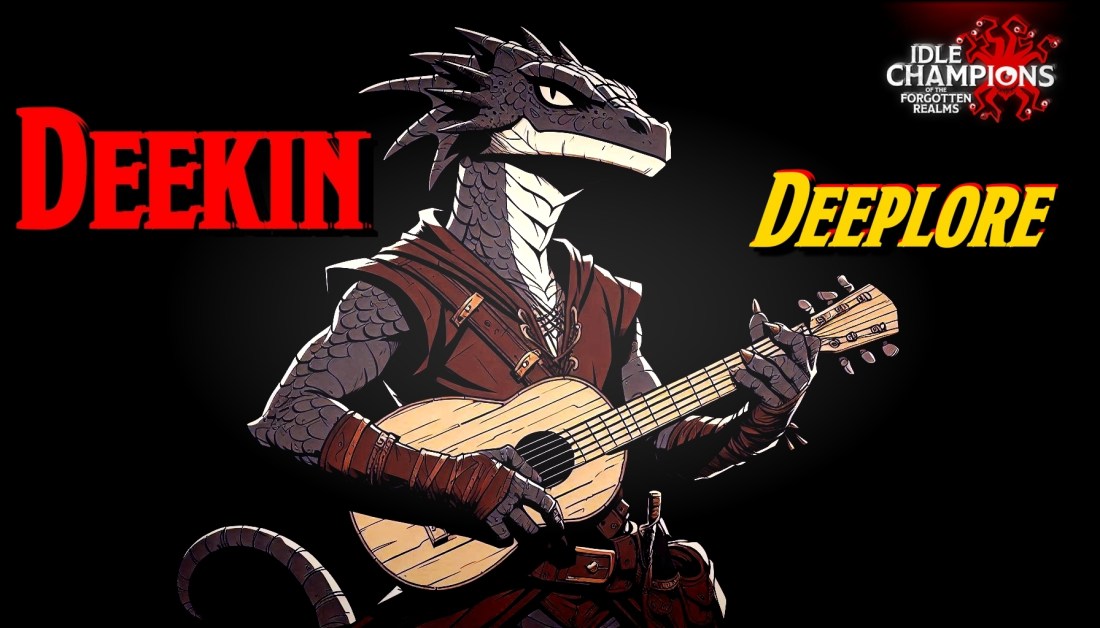
D&D Deeplore: Deekin Scalesinger – The Kobold Who Shouts DOOOOOM!

Deekin Scalesinger – a kobold bard with trembling scales, a quavering voice, and a heart that refuses to shrink to match his size. To many, he appears as comic relief: anxious, excitable, forever teetering on the edge of panic. A creature who shouts “Doom!” with such earnestness that it almost sounds like prophecy. But Deekin is not a joke.
He is a spark.


He does not dominate the battlefield through strength or spellcraft. He shapes its tempo through emotion. He does not command through authority. He commands through belief. And in a formation filled with giants, gods, and legends, it is the smallest voice that often pushes the story forward.

To understand Deekin, one must remember where he began. In Neverwinter Nights: Shadows of Undrentide, he first appears not as a warrior, but as a companion – nervous, earnest, and endlessly curious. Kobolds in the Forgotten Realms are fragile, numerous, and easily overlooked. They survive through traps, tunnels, and fear.
Deekin survives through narrative.

He attaches himself to heroes not because he expects protection, but because he is drawn to greatness. He believes in stories – dangerous ones, heroic ones, the kind that reshape the world. And he believes, with stubborn sincerity, that even a kobold can matter if he stands close enough to the moment where legends are forged.

He does not slow the world down. He urges it onward. He does not make the party safer. He makes the moment sharper. He does not wait for the story to unfold. He leans into it.

Deekin’s signature ability, Story of Doom, is often misunderstood. A kobold shouting “Doom!” should be comedic. And yet, somehow, those beside him grow stronger. Mechanically, it is adjacency-based buffing. Narratively, it is something deeper:

Deekin believes what he says.

When he cries “Doom!”, he is not performing. He is reacting. He feels the danger, the fragility of the moment, the sense that everything could collapse if the party hesitates. And because he feels it so intensely, those near him feel it too.

His urgency is not calculated.
His panic is not strategy.
His drama is not performance.
It is honesty – raw, unfiltered, unpolished.

And that honesty becomes strength. A routine encounter suddenly feels like a final stand. A simple skirmish becomes a moment that demands everything. Deekin does not reframe the battlefield with cold intention. He reframes it because his heart is convinced the world might end – and because he refuses to let it end quietly.

Heroes rise when someone beside them trembles and still chooses to sing.
This is not a global aura. It is not the voice of a commander shouting from afar.
Deekin inspires through closeness.

His power works best when someone stands shoulder to shoulder with him – close enough to hear the tremor in his voice, close enough to feel the urgency radiating off him, close enough to understand that his fear is real and his courage is, too.
He does not lead from a throne – he supports.

Deekin stands between heroes, small and shaking, and reminds them that the moment matters. His presence is not imposing. It is grounding. His fear does not weaken the party. It focuses them.
He does not mask his fear behind bravado. That transparency is what makes him trustworthy.
He is not the hero of the tale. He is the one who convinces the heroes that the tale is worth fighting for.

Then there is Confidence in the Boss, the ability that increases enemy spawns. On paper, it seems reckless. Why would anyone invite more danger? But Deekin’s logic is not the logic of a tactician. It is the logic of someone who grew up in a world where safety was never guaranteed.
For a kobold, danger is not escalation. It is the baseline. Tunnels collapse. Dragons pass overhead. Adventurers wander in with torches and steel.
Threats are constant, unpredictable, and rarely fair. Deekin does not see more enemies as a worsening situation. He sees it as honesty – the world revealing itself without pretense.
He does not escalate the threat. He recognizes it.
And in recognizing it, he accelerates the confrontation. If the world is going to test the party, better it test them now – while they are together, while they are ready, while the story still has breath.
This is not nihilism. It is courage sharpened by experience.

What makes Deekin compelling is not that he is powerful. It is that he is aware. He knows how small he is. He knows how fragile kobolds are. He knows how easily heroes fall. And yet he steps into formation anyway.

He does not try to become a dragon.
He does not try to become a legend.
He tries to make the moment matter.
He does not promise victory.
He promises significance.

And that is often the greater gift. In a roster filled with divine avatars and reality-bending spellcasters, Deekin reminds us that greatness is not measured in size or strength, but in the willingness to stand at the edge of doom and raise your voice anyway.

In the end, Deekin Scalesinger is not defined by his size, his fear, or even his cry of “Doom!” He is defined by the way he transforms that fear into momentum. He is defined by the way he stands close enough for others to feel his trembling – and close enough for them to draw strength from it.

He does not sing because the world is safe.
He sings because it is not.
He sings because someone must.
He sings because stories deserve witnesses.

And in singing at the edge of doom, he turns that doom into the very thing that drives the party forward.