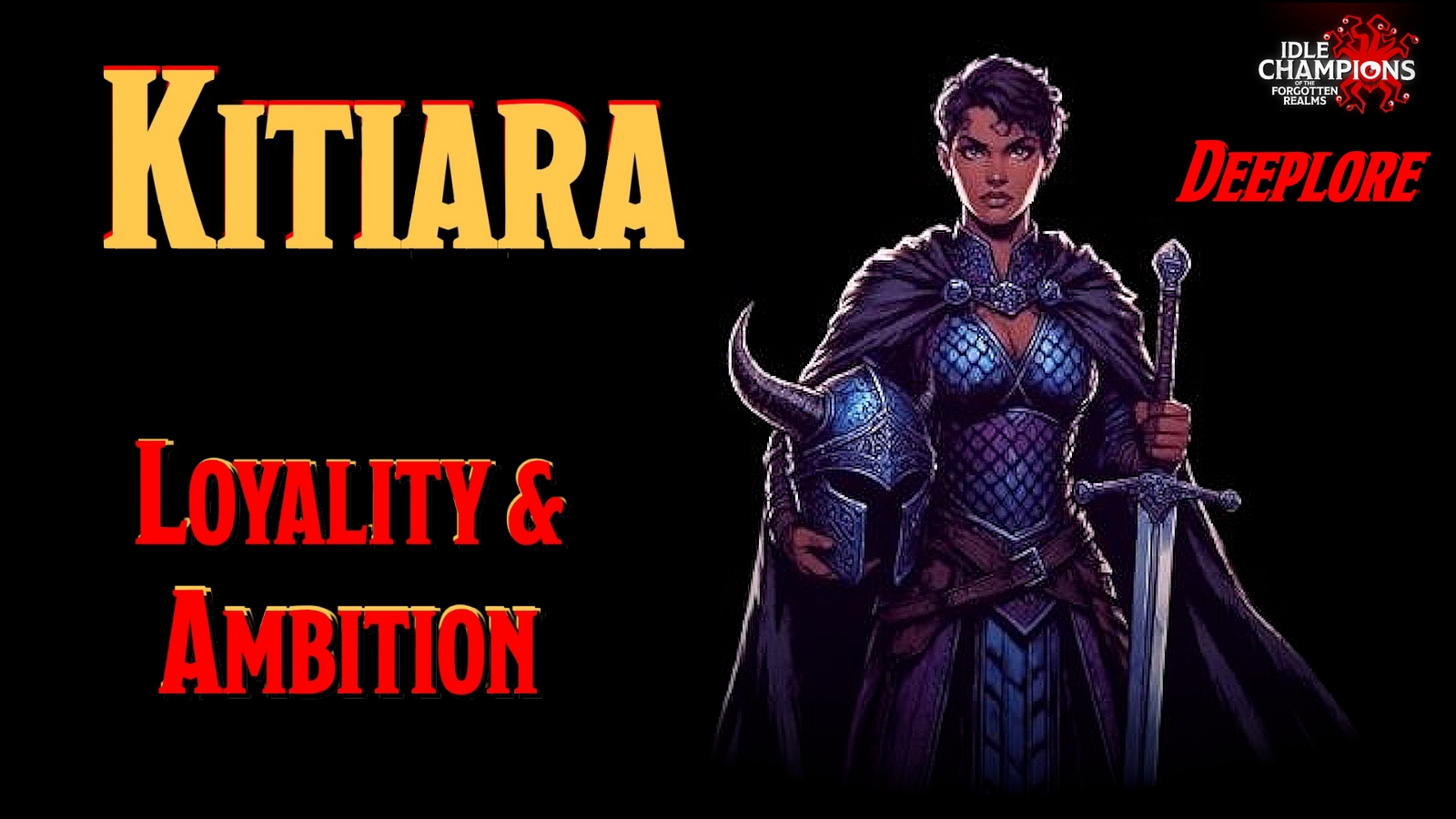

Will Kitiara Uth Matar make it into Idle Champions of the Forgotten Realms at Liar’s Night? This Deeplore looks at the choices that shaped her rise, the ambitions that drove her forward, and the consequences she never pretended were simple.
Kitiara Uth Matar has always lived in the narrow space between loyalty and ambition, and she has never tried to escape it. Strength and flaw come from the same source in her: a fierce independence that shapes every choice she makes.
She is driven by impulses that do not always align, and she has learned to live with that tension rather than resolve it. Those who know her understand she is neither simple nor predictable. Every decision carries weight, and she has never shied away from that weight.
Growing up alongside Caramon and Raistlin taught her early that the world rewards action, not potential. Caramon’s kindness made him vulnerable; Raistlin’s brilliance made him dangerous to underestimate. Kitiara saw that waiting for protection was a luxury she did not have. Independence became her default stance long before adulthood demanded it.
She stepped into responsibility because no one else would, and she never relinquished that habit. Her path as a mercenary was shaped by choices that could have ended her career before it began. Contracts others avoided became her opportunities.
She learned to judge quickly: which commander had real authority, which soldier would hold the line, which ally would break under pressure. Loyalty revealed itself as a layered thing. Some followed her out of respect, others out of fear, and others because she paid well. She never pretended otherwise. She did not demand loyalty; she managed it.
And she understood that loyalty built on ambition or fear can be just as effective as loyalty built on admiration. Kitiara’s charisma is sharp rather than warm. She listens closely, speaks precisely, and carries herself with a confidence that makes people assume she knows more than she says. She is not manipulative in the petty sense, but she uses her understanding of people to get what she needs. Flattery, threat, silence—each is a tool she wields with practiced ease.
Yet even she misjudges. Allies have surprised her; enemies have slipped past her guard. She carries those mistakes not as regrets but as reminders that clarity has limits.
Her relationships with her half‑brothers are shaped by history rather than sentiment:
With Caramon, she shares a familiarity forged in childhood, a recognition of shared origins even when their paths diverge. She respects his strength, though she sometimes overlooks the depth of his loyalty. With Raistlin, she shares something sharper: ambition. She recognizes in him a hunger that mirrors her own, though his is colder and more calculated. She does not assume she understands him completely, and he treats her with a wary acknowledgment. Their relationship is not warm, but it is grounded in a mutual understanding of what ambition can cost. They do not always speak honestly, but they see each other clearly.
Clarity is one of her defining traits, but also one of her greatest dangers. Patterns reveal themselves quickly to her; power dynamics make sense at a glance. She acts decisively, often correctly, sometimes too quickly. That decisiveness can harden into rigidity. She believes in strength, discipline, and purpose, but she can overlook the value of patience or compassion. Her certainty has led her into conflicts she might otherwise have avoided. The same blade that cuts through hesitation can cut allies as easily as enemies.
Commanding the Blue Dragonarmy is the culmination of everything she has built. It is not a destiny bestowed upon her; it is a position she carved out through competence and will. She leads with discipline and expects the same from those under her command. She is not cruel for cruelty’s sake, but she is willing to make sacrifices others hesitate to consider. Soldiers respect her, though some fear her, and she accepts both. Her alliance with dragons reflects the steadiness she brings to every encounter.
She respects their power without letting that respect become submission. Confidence is her shield, and dragons respond to it—even if their reasons remain their own. Few mortals can stand before a dragon without flinching; Kitiara stands as if she belongs there, even when she knows one misstep could mean death. One of the most defining choices of her life—joining the Dragonarmies—reveals her complexity more clearly than any personality trait. She did not join out of blind loyalty or ideological fervor. She joined because she saw an opportunity to rise, to command, to shape events rather than be shaped by them.
It was a decision that brought her power, but also conflict. It put her at odds with people she cared about and forced her to navigate loyalties that could not coexist peacefully. She justified the choice, but she did not pretend it was simple. It was a decision made with clear eyes, and she accepted the consequences even when they cut deeply. Kitiara does not seek redemption because she does not believe she needs it. She does not see herself as fallen or broken. She sees herself as someone who has made difficult choices in a difficult world.
But she is not blind to the effects of those choices. Ambition has shaped her relationships, her opportunities, and her reputation. Clarity has hardened into stubbornness. Independence has become isolation. She accepts these things not with pride, but with the same practicality that guides all her decisions. She justifies her choices, but she does not pretend they were costless. In battle, she is relentless. Purpose drives her movements; precision defines her strikes. Authority radiates from her presence. Yet she is not infallible. Confidence can lead her to underestimate an opponent. Decisiveness can make her commit too early. Ambition can push her into risks others avoid. She wins because she adapts quickly, not because she is perfect. And when she loses, she does not always learn the lesson others expect.
Sometimes she draws conclusions that reinforce her independence rather than soften her resolve. She folds each outcome into her understanding of the world and moves forward, even when the path ahead is steep. Beyond the battlefield, she navigates politics, alliances, and rivalries with the same tactical awareness she brings to war. Directness serves her well, but it can also be dangerous. She pushes hard, assumes much, and trusts selectively. Adaptable but not patient, resilient but not gentle, effective but not always right—her strength is real, but it is not effortless. It is something she maintains deliberately, sometimes at the expense of connection. Kitiara Uth Matar is not a hero in the traditional sense, nor is she a villain. She exists in the space between, a space she occupies with confidence and purpose. Experience, ambition, and an unwavering belief in her own capability shape her path. She is the kind of presence that does not need to be introduced; she announces herself simply by walking into the room. And once she is there, the room does not change because she demands it. It changes because she acts, and her actions have weight. She brings something different: a reminder that strength is complicated, ambition dangerous, and leadership rarely simple. She is built not from prophecy or divine favor, but from grit, discipline, and a lifetime of choices made with clear eyes. She is a warrior, a commander, and a presence that cannot be ignored. And when she steps into any story, she does so not as a symbol of hope or redemption, but as a testament to the power—and the cost—of carving one’s own path.

